News   Feb 05, 2024
 2K     0 
News   Jan 27, 2020
 2.2K     0 
News   Nov 14, 2019
 2.3K     0 

Canevas (Formerly Place Cartier) [Hull] | ?m | ?s | Brigil | ?

https://www.theglobeandmail.com/business/industry-news/property-report/article-quebec-mall-redevelopment-to-take-landscape-first-approach/


Quebec mall redevelopment to take landscape-first approach​

Andrea Yu
Special to The Globe and Mail
Published 2 hours ago
Open this photo in gallery:

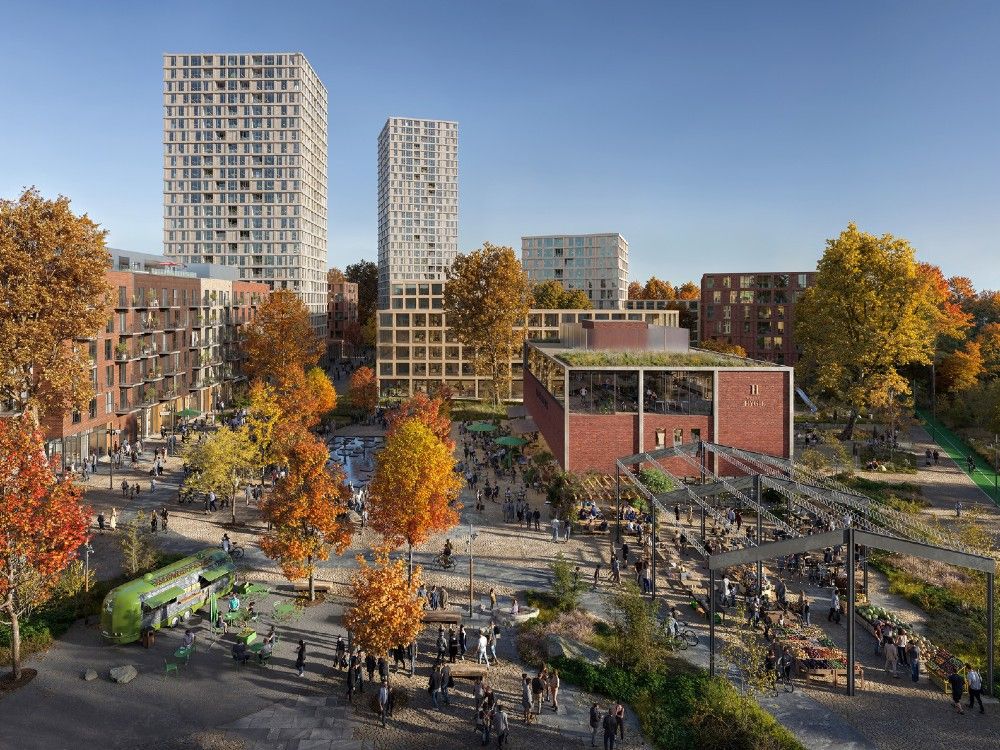
A new multipurpose development — dubbed Espace Canevas — in Gatineau, Que., will combine 192,000 square feet of retail space, 180,000 square feet of office and community space, 2.4-million square feet of residential space, and 120,000 square feet of parks and public space.Supplied/HISM – Perkins&Will

A new, repurposed mall in Gatineau, Que., is leading the charge of retail centre reinvention amid the rise of e-commerce and the changing ways Canadians are shopping.
The $1.3-billion project, named Espace Canevas, is redeveloping a 16-acre site with 192,000 square feet of retail space, 180,000 square feet of office and community space, and 2.4-million square feet of residential space, equivalent to about 2,600 units. Espace Canevas also includes 120,000 square feet of parks and public space, and 1,600 new trees, putting 33 per cent of the site under an urban tree canopy.

The large-scale, mixed-use development will take 10 to 15 years to complete, with the first phase – a six-storey building with commercial space on the ground floor and 140 residential units above it – slated for completion in fall of 2026.
The redevelopment of Espace Canevas aligns with a broader trend to reimagine Canada’s shopping centres into vibrant, mixed-use communities and cultural hubs that act as strong community anchors. This trend is already taking shape in provinces such as Ontario, British Columbia and Alberta.

Prioritizing landscape over buildings​

When it came to envisioning the project, Danish nature-based design studio SLA was tapped to work on the landscape alongside Canadian architecture firm Perkins&Will, known for its human-centric approach.

The destination takes inspiration from SLA’s hometown of Copenhagen, where the project teams spent time exploring sites such as the Carlsberg City District – a former brewery and industrial space that was recently redeveloped into a mixed-use neighbourhood with historic buildings, residences, office space and restaurants.

Dan McTavish, design principal at Perkins&Will, says his team was able to execute a human- and environment-forward design by first planning these elements to be as beneficial and cohesive as possible before placing “built forms” – or buildings – around them. In other words, his team planned and placed the landscape before focusing on the destination’s structures.

“We have a tendency in North American urbanism to think about built form first,” Mr. McTavish explains. “What we really tried to do here was take the opposite approach of thinking: What are the spaces and experiences that we want to create in the public realm, and how does the built form shape and support that? So, built form came almost last in the process, whereas normally it would come first.” A good example is Espace Canevas’ bike-lane network, which encourages car-free movement – one of the project’s goals.

“We have a high-speed bike lane [through the middle of the site] because that’s the smart shortcut,” says Rasmus Astrup, SLA’s design principal and partner, who explains that similar redevelopments might typically redirect bike traffic around the perimeter. “The fact that a shortcut bicycle lane takes you through the entire site is really unique.”

Integrating water and nature​

Another ecology-forward element is the site’s water management design.

Instead of directing rainfall into drains, sewers and underground infrastructure, SLA and Perkins&Will wanted to make stormwater management an above-ground feature, also known as “daylighting rainwater.” They accomplish this by using bioswales – manufactured creeks designed using the site’s natural slopes that channel water into above-ground retention basins to safely collect rainwater.

“Daylighting rainwater allows it to be collected and absorbed into the ground in a more controlled manner,” Mr. McTavish says. “This reduces the need for below-grade civil infrastructure to move the water into storm systems that are increasingly being overwhelmed by more severe storms.” More open water areas also improve biodiversity, supporting insects, birds and plants.

Imagining and designing the site’s tree plantings was also something that Perkins&Will and SLA prioritized. Mr. Astrup says typical North American development sites often see trees as an afterthought. “You wait and see what’s left,” he says.

Mr. McTavish says the team identified planting areas where trees could be clustered together for a more forest-like approach. “It’s not only how many trees, but what trees can people see,” he explains. “We’re trying to think from every space, from every window, how are we seeing at least three trees?”

Open this photo in gallery:

A former cinema will be retained and transformed into a future community space complete with restaurants and cafés on the ground floor, with activities and community space on the second and third floors. A large metal canopy will also be retained next to the cinema to host events, markets and more.Supplied/HISM – Perkins&Will

Building on historical structures​

Taking inspiration from the adaptive reuse of historic buildings, such as a former bottling-hall-turned-fitness-centre-and-doctor’s-office in Copenhagen’s Carlsberg City District, Espace Canevas retains one building – a former cinema – that will become a community space.

Jessy Desjardins, vice-president of development and conception at Gatineau-based Brigil, the project’s developer, says the cinema is one of the oldest in the area and it was well-loved by the community, inspiring its adaptive reuse.

“It’s going to be a three-storey building with restaurants and cafés at the ground floor and some activities and community space on the second and third floors,” Mr. Desjardins says.

Preserved from the original mall, a large metal canopy will also be retained next to the cinema, to host public outdoor events, markets and other activities. Mr. Desjardins says he hopes institutional spaces such as a library could also find a home in a future phase of Espace Canevas.

Parks, water features and mini-forests are also part of the public space plan at Espace Canevas, meant to be enjoyed by the site’s residents and surrounding community. “Our vision is that by developing this site, we’re giving space to the people in this neighbourhood and creating more walkable environments,” Mr. Desjardins explains.

A sustainability focus​

Making it easier for residents and the community to bike, walk or take transit also has climate-positive appeal. “We’re really leaning on how we can create a community that is built around and for people, and to reduce the dependency on cars,” Mr. Desjardins says.

These types of climate-adaptive, sustainability-focused developments could soon become the norm, according to Tonya Lagrasta, global head of sustainability at real estate company Colliers.

“It’s really becoming table stakes,” she says of climate and sustainability. “I think there’s a general expectation that anything that is going to be created has sustainability principles in mind and that they are integrated.” One sustainability-minded design feature Ms. Lagrasta points out, and that Espace Canevas prioritizes, is water management. She says it not only accounts for rainfall but also the collection of surface water and the freeze-thaw cycle in the shoulder seasons.

“It becomes a property management issue and requires more salt and people power, which all comes with an associated price tag,” Ms. Lagrasta says of the cycle.

Lower-maintenance spaces are advantageous – not only from a climate perspective but also when it comes to organizations’ bottom lines, Ms. Lagrasta says.

“If you can find a way to have nature do a lot of that work, that’s a pretty good solve.”

 
Phase 1 right now

I really like how they broke up the facade with different materials.

4289.jpg
 
Looks pretty good. Saint-Joseph is slowly becoming a decent urban street. Could be the Gatineau equivalent of Westboro.
 

Homes: Long-neglected mall to become a new neighbourhood that offers it all​

By Anita Murray, Ottawa Citizen
Published Dec 11, 2025

1766505206181.png


Place Cartier became the Outaouais’s first mall in 1965, just a few short years before Joni Mitchell released her classic 1970 song Big Yellow Taxi with the line “they paved paradise, put up a parking lot” — a call to action to stop the damage to our planet.

Fifty-five years later, developer Brigil is heeding that plea with a $1.3 billion vision to turn the long-neglected mall back into something much more appealing. It’s a long way from a fait accompli, but Brigil has taken the first steps towards transforming the 17-acre concrete desert at Saint-Joseph and Saint-Raymond boulevards as it waits for Gatineau’s updated strategic plan to be put into place so that it can present the master plan to the city.

1766505341557.png


“It’s clear that business models for commercial centres are evolving, especially in today’s economic context. This idea of city-in-city development is an interesting response to that shift, by bringing housing options closer to services,” Hull-Wright Coun. Steve Moran said of the project via email. “It’s encouraging to think that residents could benefit from new green spaces and local shops designed to be easily accessible on foot or by bike. That said, we’ll need to see the formal plan filed with the city before offering a more detailed opinion.”
Article content

Brigil founder Gilles Desjardins saw the potential of the site back in 2018, but his sons Kevin and Jessy, who both work with their father, took a little convincing. “Our first reaction was don’t touch it … it’s going to be super hard to redevelop and bring life to it,” remembers Jessy Desjardins, who is Brigil’s vice-president of development.

1766505229796.png


But his father shared how he saw the redevelopment, which included a mix of apartment residential, commercial space, public gathering spaces and plenty of nature, with taller buildings positioned along the main streets and lower ones at the back of the property, where it meets a neighbourhood of mostly bungalows and two-storey singles.

“And then it clicked,” Jessy says. “Kevin and I were like, ‘Oh my God, this is so cool.’” And so was born Espace Canevas, an empty canvas that “had that potential to start from a blank state and become something much bigger.”

Jessy Desjardins has become such a proponent of the project that he led a team to Copenhagen, Denmark, earlier this year to meet with global landscape architecture firm SLA, which helped refine the vision for the project’s outdoor spaces.

At its core is an outdoor plaza reminiscent of Ottawa’s Parkdale Market, where events can be held under string lights and a giant pergola made of the old mall’s skeleton. It will sit next to the only portion of the mall to eventually remain: the old cinema building that is nostalgic for many in the area. Smaller plazas will dot the property and cutting through it will be a treed bike path that connects Rue Gamelin and its nearby giant park and the rest of the development.

Surrounding the core will be several buildings, a mix of residential, commercial, retail and possibly institutional with the potential for 2,600 residential units, 192,000 square feet of commercial space and 182,000 square feet of office space.

Every step of the way, Brigil — which has since moved its head office to an existing office building on the site — has been careful to include the community. Shortly after buying the property, the company met with the two community associations in the area and conducted a survey to find out what residents wanted: a mix of housing and commerce, restaurants, other activities and cultural possibilities — needs that Rejéan Laflamme, president of the Association des Résidents Parc de la Montagne, feels Brigil is so far meeting.

“It’s wonderful, I think,” Laflamme says of Brigil’s proposal. “It was just a big parking lot that wasn’t used to the full potential. What Brigil is proposing is to use it completely.”

1766505261499.png


One of the first things Brigil did was to animate the mall’s back alley and connect it to the existing neighbourhood by cutting large doors in the façade so restaurants and other businesses in the back of the mall could open them up and have a “street presence” with patios facing the afternoon sun and the neighbourhood. It also added colourful murals to the exterior, installed seating in the hill by the alley for outdoor movie screenings and added benches and planters to liven the space.

“It allows us to use the back alley as a community space and event space,” Desjardins explains as he sits at one of the patios in the late summer sun. “On weekends we can have markets, we can have events.”

It’s part of how the company is working to develop a project that will evolve well over time, partly because it’s an ambitious plan that will take many years to complete and may need to shift with market changes, and partly because the Walmart on site has a lease that’s not due to expire for decades, which means it will be some time before the full vision of the project is realized.

In the first 15-20 years, Brigil expects to build about 1,600 residential units, with another 1,200 or so once Walmart departs. And about 60 per cent of the property will be devoted to outdoor spaces.

“We didn’t want to just have an empty mall, demolish it, then a construction site for five, 10 years and then hopefully having some interaction in the community afterwards,” Desjardins explains. “We wanted to create something that, from the get-go, had a sense of community, a sense of neighbourhood and culture, and help local businesses to set up shop.”

Even though Brigil does not yet have full site plan approval, construction is progressing on the first residential building, a six-storey rental building along Saint-Joseph that’s expected to be finished next summer. Phase two will be a tower on the northwest corner at Rue Berri and Saint-Raymond, where a Goodyear tire shop currently stands. It will have 12 to 15 storeys and will likely be rentals as well. Brigil is hoping for approval on that building in time to start construction as the first building finishes.

It’s a bit of a leap of faith to go ahead with parts of the project when the whole thing has not yet been approved, but Desjardins says the buildings are going up in such a way that any changes needed to the master plan won’t derail the vision.

1766505294315.png


Isabelle Cousineau, who was elected councillor for Parc-de-la-Montagne-St-Raymond, the district in which the project is located, in the November municipal election, is cautiously positive about the plan.

“The project, as publicly presented, does address some of our needs — especially the idea of creating a place where people can live, access services nearby and enjoy a well-rounded, complete neighbourhood,” she said via email. “But we also have some pressing challenges. Affordable housing is one of the biggest. The types of units typically found in this kind of project aren’t within reach for a significant portion of our population.” (The current plan includes 10 per cent affordable units.)

Desjardins is confident it will all work out. “You need three groups for a good project: the developer, the citizen and the city,” he explains. “The citizen — the residents — are quite on board, really happy. We’re quite excited, obviously, and I think the city is excited as well, so hopefully that will go very well.”


Back
Top